
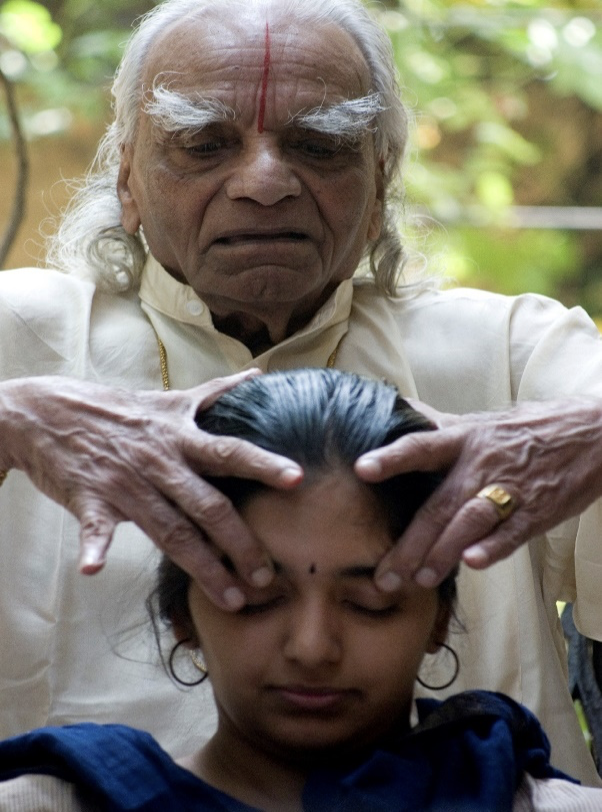
Isvara Pranidhana (Surrender)
pronounced Ish-va-ra-pra-nid-hah-na
“Tapas means passion in the art. We must immerse ourselves in each asana and in each breath. Svadhyaya is to study the movements that happen in the practice of asana, and to reflect on them and then to remove those disintegrations that happen and bring integration – where the “I” (ego) is sanctified and purified. That is Isvara Pranidhana.”
E. Bryant says Isvara-pranidhana is the dedication of all action to God, Isvara, and the renunciation of the desire of all the fruits that might accrue from one’s action.
The Yoga Sutras of Patanjali: Edwin F. Bryant, p.181
While we understand Isvara Pranidhana to mean surrender, we may think and describe it as the ‘easiest’ path to peace and realization, requiring no effort or pain on our part – we simply let go, devote everything to a higher power (Isvara) and completely devote our actions to whatever we consider that higher power to be…. But as stated above, in every aspect, there is Tapas, there is Svadhyaya and there is Isvara Pranidhana. The body, mind, and consciousness, all three need to undergo the transformation and purification in a gradual but sequential manner to digest and assimilate these principles into the deeper system of citta.
B.K.S. IYENGAR, Light on the Yoga Sutras of Patanjali states
II.1 तपःस्वाध्यायेश्वरप्रणिधानानि क्रियायोगः
Burning zeal in practice (Tapas), self-study (Svadhyaya) and the study of scriptures, and surrender to God (Isvara Pranidhana) are the acts of yoga.
This sutra to me represents “Triveni Sangam” which means the confluence of three rivers that is a sacred place. With a bath there you are free of all your sins, and one attains samadhi. I see this sutra as a confluence of Sadhana Traya: Tapas, Svadhyaya and Isvara Pranidhana.
So, why is Isvara Pranidhana considered the most profound of the Sadhana Traya?
“Through surrender the ego is effaced, and grace pours down upon him like a torrential rain. When the feeling of “I” and “mine” disappears, the individual soul has reached full growth.”
Light on Yoga by B.K.S. Iyengar, p.39
B.K. S. Iyengar has further clarified that to reach this level of purification and grace, tapas and svadhyaya come first and evolve in a sequential order to gradually transform the consciousness for Isvara pranidhana.
“The body is the outer cover of the mind. The mind is the outer cover of the consciousness, and the consciousness is the outer cover of the soul.”
Astadala Yogamala, Volume 3, B.K.S. Iyengar, page 63
In Iyengar Yoga we start with the body practicing asanas, applying the first traya, tapas through immersing ourselves in each asana and each breath. As we practice over time, the mind reflects on the sensations within and svadhyaya, the second traya or self-study is incorporated.
“Each aspect is followed by the physical body at the first level to bring purification of the body. Then the body is connected to the mind. The defects and tricks of the mind are detected. The mind is cleansed by eradicating these defects in each aspect and finally the body and mind are connected to consciousness. The consciousness is purified by taking off the unwanted, defective, and painful vrtti (disturbances).”
Astadala Yogamala, Volume 3, B.K.S. Iyengar, page 64
So how does the practical application of Isvara Pranidhana transform my asana practice and continue to do so…

During my asana practice, I must first train my mind to completely surrender to the asana, let go of my aversions (dvesha), before I begin the practice of svadhyaya to watch what is coming and what is not coming, what is happening and what is not happening, study the specific movements, then to reflect on them and finally bring integration. The word ‘surrender’ may come across as weak but surrendering to the asana in my asana practice is in no way weak at all, it is in fact the strongest thing I can do.
Patanjali says the mind and intelligence are connected to the entire skin of the body. As the skin envelops the inner contents of the body, it cannot be said that it has no intelligence here or has intelligence there. Skin being the cover of the flesh, I had to learn to move the inner body in such a way that the various layers of the skin are touched gently and not aggressively.
At the beginning stage of my practice, I was performing mechanically, going up in Salamba Sirsasana II straightening my legs, pressing my palms down, lifting my shoulders, buttocks away from the head working at gross level. Then with continuous practice, I began the inner dialogue with myself, my body and my mind and started noticing that I was more on the forehead side of the head rather than the crown, was not pressing the left thumb mound on the floor as much as the right as a result of which my forearms were not parallel to each another and right side of the skull was pressing more into the mat than my left side. Correcting these imperfections in practice is to invoke the intelligence to seep in, one has to soak the body, mind, and speech in Isvara Pranidhana.
Tejal Merchant